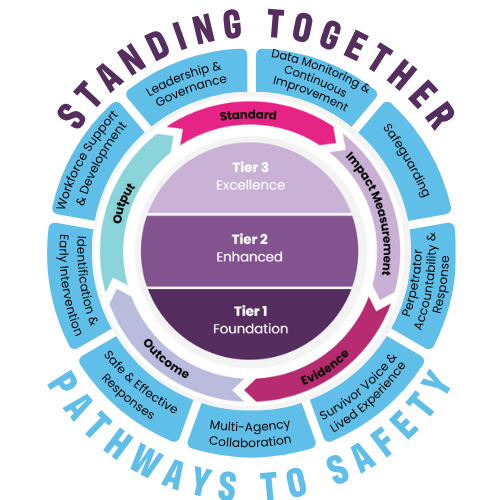

Pathways to Safety
Domestic abuse is a public health issue with serious and lasting impacts on individuals, families, and communities. Health services are often a critical point of contact for victims and survivors - sometimes the only service they may access. Yet despite growing recognition of this, the response across health settings remains inconsistent.
We’ve heard this time and again: what’s missing is a clear, structured, and supportive framework that raises the standard of care and enables health professionals to confidently and effectively respond to domestic abuse.
That’s why we’ve developed Pathways to Safety - an accreditation framework built from real-world experience, learning, and sector feedback. It provides a consistent, quality-assured structure that promotes better outcomes for victims, survivors, and families, while supporting staff and holding systems accountable.
Pathways to Safety is a national Accreditation Framework designed to support healthcare providers in England to strengthen their response to domestic abuse and become domestic abuse-informed, inclusive, and equity-driven Trusts and Integrated Care Systems (ICSs).
Grounded in the principles of the Coordinated Community Response (CCR) of shared organisational responsibility, survivor-centred practice, perpetrator accountability, and multi-agency collaboration, the framework aims to embed consistent, survivor-centred, safety-led, trauma-informed, and culturally responsive practices across healthcare settings. A truly domestic abuse-informed system will be equitable, accessible, and inclusive of all survivors, recognising that domestic abuse affects people differently based on intersecting factors like race, disability, gender, and migration status.
The framework follows a tiered accreditation model, designed to be achievable, scalable, and adaptable for different healthcare contexts. It enables Trusts and ICSs to progress at a pace that supports sustainability while embedding meaningful change. Participating Trusts and ICSs are encouraged to demonstrate progress and impact using locally appropriate approaches, reflecting their unique geographic, demographic, and resource contexts. The framework has been designed with the flexibility that is required to support genuine engagement, promote innovation, and drive system-wide change across the national health sector.